Alintro: IoT-Based Vertical Hydroponic System for Urban Farming
Alintro is a device that combines two hydroponic systems, NFT and vertical, built on the Internet of Things (IoT). Compact and mobile, it adds app-based monitoring and automated control of nutrients, lighting, and weather protection for growing crops in limited urban space.
Project Overview
In 2021 the number of motor vehicles reached 143,797,227 units, and CO2 emissions reached about 259.1 million tons, driven largely by fossil-fuel combustion from motorized transport. Green technology and urban farming are two ways to respond, and hydroponics allows crops to be grown on open spaces within communities without relying on soil.
Alintro is a device that combines two hydroponic systems, NFT and vertical, based on the Internet of Things (IoT), so that nutrient levels, lighting, and weather protection can be monitored and controlled from an app.
Alintro was developed for the HVL National Competition (Green Technology & Sustainable Engineering) organized by the High Voltage Laboratory of ITS, under the theme Internet of Things (IoT) for Green Technology Implementation. The project was carried out by a team of three: M. Nizaar Musyaffa, Jesica Zalsa Amalia M., and M. Zulfi Huda Al-Haq.
Objectives & Benefits
- Reduce CO2 emissions and increase O2 in the surrounding environment.
- Raise public awareness of environmental issues through a visible, easy-to-adopt urban farming product.
- Increase planting capacity per square meter compared with conventional horizontal hydroponic layouts.
System Design
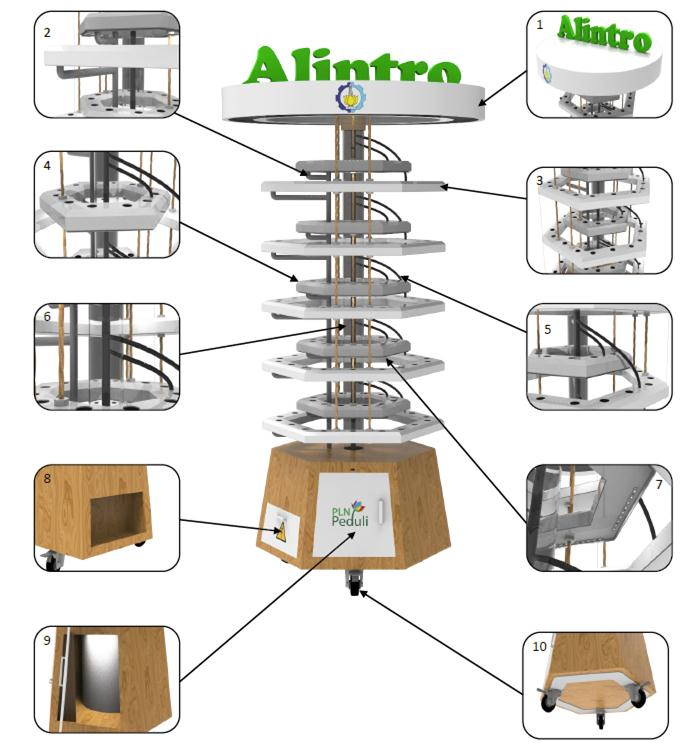
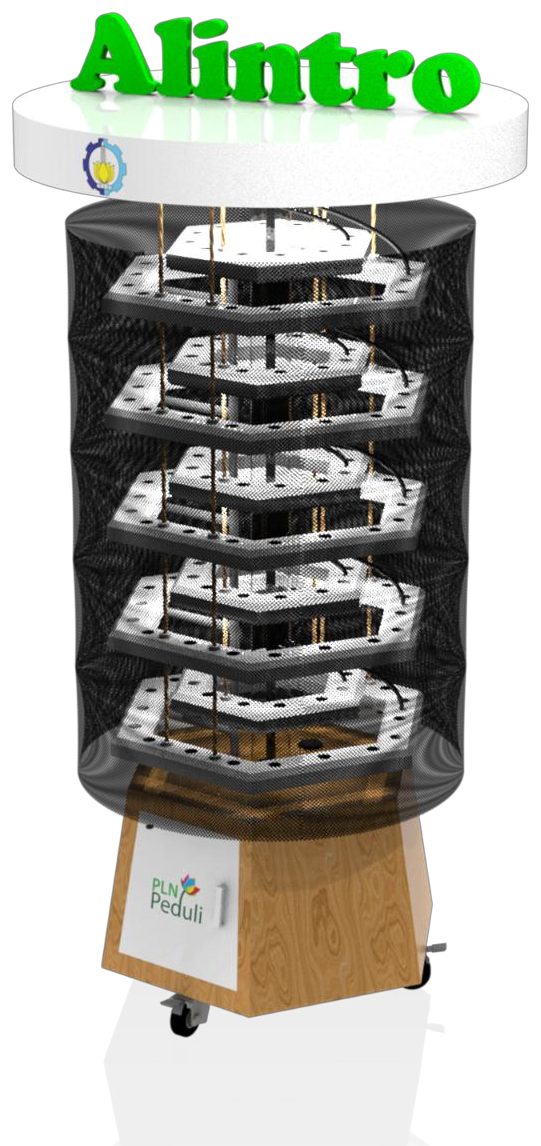
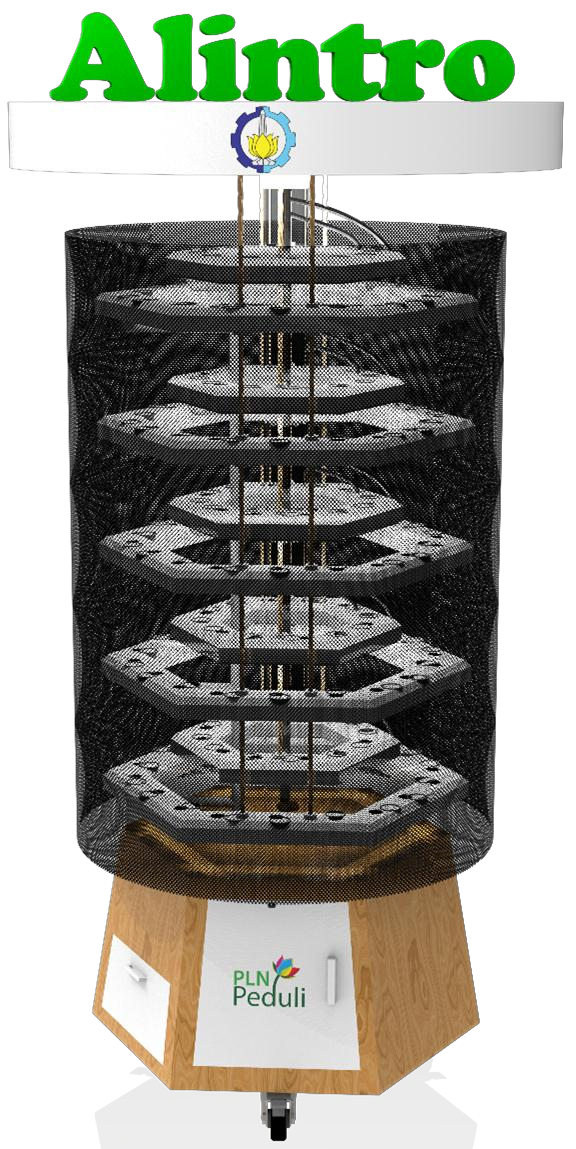
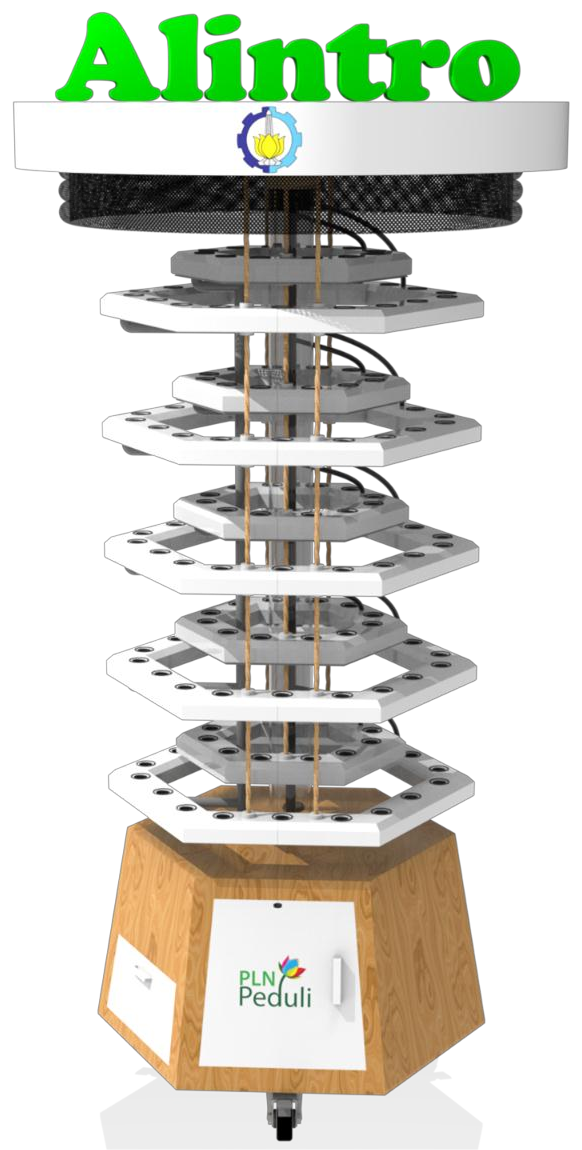
Alintro is a hexagonal multi-tier tower on a wooden base with caster wheels. Planting holes are split between two gully types, while the electrical box, reservoir, and pumps are housed in the base so the unit can be moved and placed in limited spaces.
Combined System
Vertical farming merged with NFT hydroponics in a single mobile tower
Microcontroller Unit
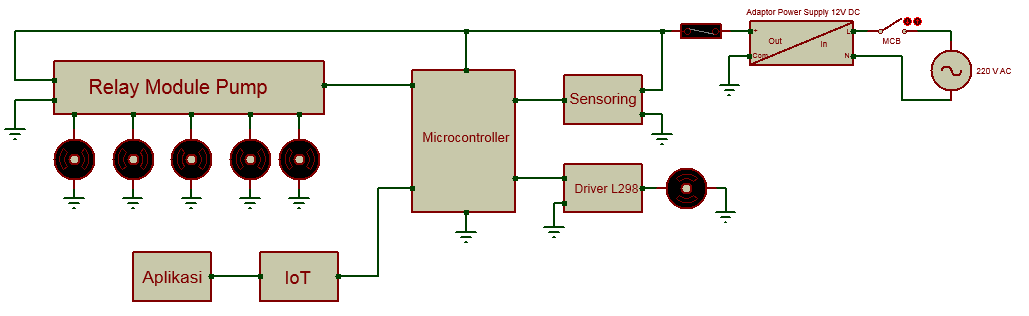
Sensors feed a microcontroller that switches pumps through a relay module and drives the motor output
Monitoring Application
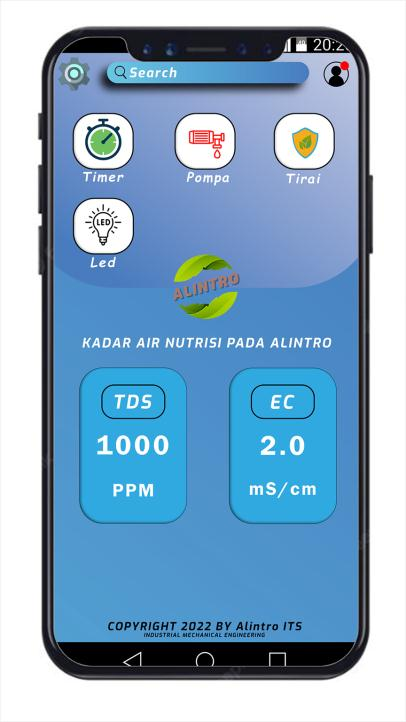
Mobile app shows nutrient TDS and EC and provides timer, pump, curtain, and LED controls
Electrical Protection
MCB and fuse protect the 220 V AC input feeding the 12 V DC adaptor
Hardware Components
- Microcontroller – Central unit connecting the sensors, pumps, motor driver, and IoT link
- PH & TDS Sensors – Monitor nutrient solution acidity and concentration
- LDR Sensor – Measures ambient light level
- Raindrop Sensor – Detects rain for the rain notification feature
- FS300A Sensor – Water-flow sensing in the circulation line
- Relay Module – Switches the reservoir pump and the nutrient/pH pumps
- L298 Motor Driver – Drives the motor of the automatic curtain
- 12 V Submersible Pump – Circulates nutrient solution from the 120 L reservoir
- LED Grow Lights – Supplementary lighting on each tier
Component Functions
Numbers follow the component layout above.
| No. | Component | Function |
|---|---|---|
| 1 | Roof Cover | Houses the paranet curtain and protects the drive motor and other electrical components |
| 2 | Output Pipe | Carries nutrient water out of the gullies and returns it to the reservoir |
| 3 | Gully A | 18 planting holes on each tier, 5 tiers |
| 4 | Gully B | 12 planting holes on each tier |
| 5 | Input Hose | Carries nutrient water from the reservoir to each gully |
| 6 | Clear Pipe | Covers and protects the electrical parts |
| 7 | LED Lights | Light the hydroponic plants when there is no sunlight |
| 8 | Electrical Box | Contains all the components required by the system |
| 9 | Water Reservoir | Stores the hydroponic nutrient water |
| 10 | Caster Wheels | Make the product easy to move |
Technical Specifications
| Parameter | Value |
|---|---|
| Dimensions | 130 × 130 × 300 cm |
| Weight | 30 kg |
| Planting Capacity | 150 netpot holes (Gully A 18 per tier × 5 tiers = 90; Gully B 12 per tier = 60) |
| Reservoir Capacity | 120 liters |
| Pump | 12 V submersible, 1200 L/h |
| Body & Reservoir Cover | Wood |
| Trapezoid Gully | PVC |
| Roof Cover / Structure | Aluminium sheet / wood |
| Mobility | Caster wheels |
| Estimated Energy Use | 18.54 kWh per month |
Key Features & Analysis
Alintro was positioned against two common hydroponic products, a large NFT installation and a small hydroponic kit, and differentiated through automation, IoT monitoring, and higher planting density per footprint.
Comparison with Existing Products
Compared with a conventional NFT installation and a household hydroponic kit, Alintro is the only option in this comparison that automates nutrient dosing, LED lighting, and the curtain, and provides rain notification and a monitoring app.
| Product | Dimensions (cm) | Gross Weight | Planting Holes |
|---|---|---|---|
| NFT Irifarm | 1030 × 120 × 220 | 50 kg | 1000 |
| Hydroponic Kit | 55 × 38 × 30 | 10.5 kg | 40 |
| Alintro | 130 × 130 × 300 | 30 kg | 150 |
| Product | System | Nutrient | LED | Curtain | Rain Alert | Monitoring App |
|---|---|---|---|---|---|---|
| NFT Irifarm | NFT | Manual | No | No | No | No |
| Hydroponic Kit | NFT | Manual | No | No | No | No |
| Alintro | NFT & Vertical | Automatic | Automatic | Automatic | Yes | Yes |
Brand Positioning
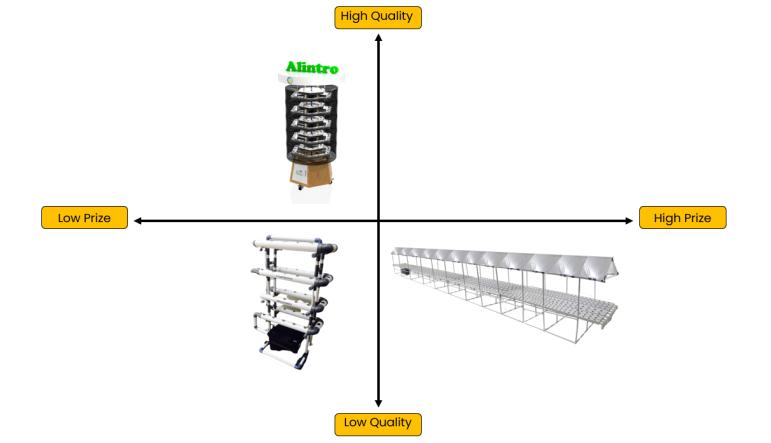
Alintro has a unique design that sets it apart from other hydroponic products. Its position relative to existing products is shown below, using price and quality as the two axes.
NFT Irifarm is 1030 cm (about 10 m) long, so it needs far more land than Alintro. It has more netpots, but its price is relatively high and its features are still manual, which places it in the high price, low quality quadrant.
The hydroponic kit sits in the low price, low quality quadrant: its dimensions are smaller, it has fewer netpots, its price is relatively cheap, and its features are still manual.
Alintro is positioned in the high-quality, low-price quadrant, backed by automated features and app-based monitoring.
Mobile Monitoring Application
The IoT application gives users remote access to the nutrient solution status, showing TDS (ppm) and EC (mS/cm) readings on the home screen. Shortcut buttons provide access to the timer, pump, curtain, and LED controls.
Paranet Curtain & Supplementary Lighting
A paranet curtain around the tower opens and closes automatically. It breaks up rainwater so that it does not enter the hydroponic system, and it limits sunlight exposure for plants that do not need too much of it. LED lights on each tier supplement natural light. Lighting follows a photoperiod guideline of 16 hours of light and 8 hours of darkness, with the lamp placed about 12.5 inches (≈ 32 cm) from the plants.
Land Utilization
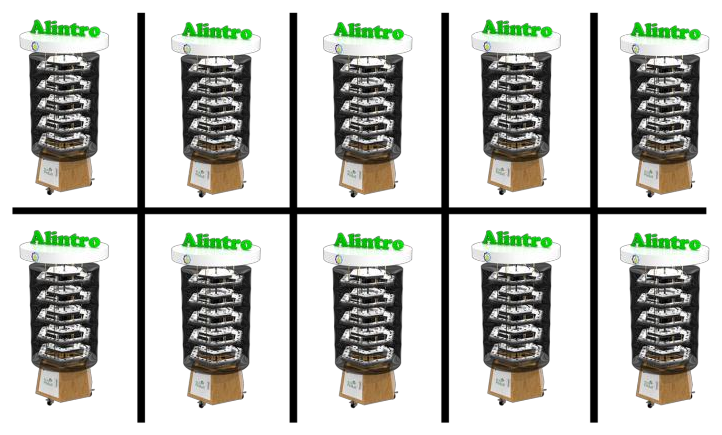
On a 10 × 10 m plot, a conventional hydroponic installation holds about 2,250 planting holes. Using Alintro on only a 5 × 5 m area, 25 units provide 3,750 planting holes, roughly 1,500 more holes on one quarter of the land.
Electrical Safety Design
To prevent damage to the electrical parts, Alintro uses an MCB and a fuse as protection components in the electrical installation. If a short circuit occurs, either the MCB or the fuse disconnects the power from the voltage source. The 220 V AC supply passes through both before reaching the 12 V DC power adaptor, which feeds the microcontroller, sensing unit, relay module for the five pumps, and the L298 motor driver.
Energy Consumption Estimate
The control system and reservoir pump run continuously, the nutrient and pH dosing pumps run in short cycles, and the LED runs a few hours per day. Together they add up to an estimated 18.54 kWh per month.
| Component | Daily Operation |
|---|---|
| Control System | 24 h |
| Reservoir Pump | 24 h |
| Nutrient & pH Pumps (×4) | 1.5 h (5 × 30 min) |
| LED | 4 h |
Market Research
Market research generally takes two forms. Primary research gathers information directly about customers and the target market and is useful for market segmentation, while secondary research analyzes data and records that already exist. For Alintro, the team carried out secondary market research to analyze market conditions. The data it produced served as input for the product design and, later, for the marketing strategy.
Findings
- Hydroponic users still check nutrient levels manually.
- Users complain about rainfall affecting their crops.
- Alintro only needs monitoring through an app, which makes the product easier to use.
Planting Procedure
- Seeds are sown for 7 days, until the third leaf appears.
- Seedlings are then transferred into Alintro using netpots.
- Water with a low ppm level is used when filling the system.
With the paranet curtain, automated nutrient, lighting, and curtain control, and rain notification, users only need to monitor the system through the app.
Project Outcome
Alintro presents a compact vertical hydroponic design that combines NFT hydroponics, IoT monitoring, and automation of nutrients, lighting, and the weather-protection curtain in one mobile unit of 130 × 130 × 300 cm with 150 planting holes.
The design targets urban spaces with limited land, offering higher planting density per footprint than conventional layouts, low estimated energy consumption, a paranet curtain against rain and excess sunlight, and electrical protection at the power input, while supporting the wider goal of reducing CO2 and raising community awareness of green technology.