Conceptual Design of a Remote-Controlled Oil Boom Vessel
A Project Based Learning study, in collaboration between ITS and Pertamina, that designs a remotely-operated vessel to tow an oil boom float and isolate spilled oil in shallow waters and jetty areas that larger containment ships cannot reach. Three implementation strategies — a new-build hull, a partially modified Pertamina vessel, and a fully modified Pertamina vessel — were designed and modeled as candidate routes for the partner.
Introduction
Oil spills at sea are a serious cause of environmental damage, and shallow waters and areas beneath jetties are especially difficult to service — large containment vessels cannot maneuver there, so isolation work is still done largely by hand. An oil boom is the standard tool for containing a spill, but something is still needed to tow the float into position without putting an operator or a full-size vessel into the contaminated area.
This project designs a remotely-operated vessel that tows an oil boom float to isolate spilled oil in shallow water and near-jetty areas. It was developed as a Project Based Learning (PBL) collaboration between ITS and Pertamina during the Even Semester 2022/2023, and compares three possible implementation routes — building a new hull, partially modifying a retired Pertamina vessel, or fully modifying one — each carried through concept design, remote-control system design, and a partner proposal.
What This Project Demonstrates
- Comparative concept design across three build strategies (new-build vs. two levels of retrofit)
- Hull design and hydrodynamic modeling in Maxsurf using the Holtrop method
- RF remote-control system design (Radiolink RC6GS/R7FG and HC-12 wireless links)
- Preparation of a partner proposal submitted through ITS's Cooperation Directorate
Shallow-Water Access
Large containment ships cannot reach shallow waters or areas beneath jetties where spills also occur.
Manual Labor Dependency
Isolating a spill in those areas still relies heavily on manual human effort.
Safe Remote Operability
How can the boom-towing vessel be maneuvered from a distance without exposing an operator to the spill?
Build Route Selection
Which build route — new hull or retrofit of an existing vessel — is most feasible to implement?
Three Design Concepts
Rather than committing to a single build, the project designed and compared three routes to a working vessel, so the most feasible one could be selected once a partnership agreement with Pertamina was in place.
ITS Team Vessel
A new resin-epoxy monohull built and equipped entirely by the team, with RF remote control and brushless thrusters
Pertamina, Partial Modification
A retired Pertamina vessel keeping its original hull and thruster, with only the control system replaced
Pertamina, Full Modification
A retired Pertamina vessel keeping only its hull, with an electric outboard thruster and a new HC-12 remote system
Hardware Components
- Radiolink RC6GS + R7FG — RF remote control and receiver used on the new-build and partial-retrofit vessels, range up to 600 m
- HC-12 Wireless Module — Long-range remote link used on the full-retrofit vessel, paired with a Nextion display for battery voltage
- Resin-Epoxy Monohull — Chosen for its strength, weather resistance, and ease of shaping for the new-build hull
- Brushless Thruster KYO 20T — Propulsion for the new-build vessel (50 V, max. 20 kg thrust)
- Electric Outboard Motor — Replaces the diesel thruster on the fully-retrofitted Pertamina vessel
Remote Control & Telemetry Station
The vessel is operated through a purpose-built remote-control station. The new-build and partial-retrofit plans use a Radiolink RC6GS V3 transmitter with an R7FG receiver acting as the onboard microcontroller, while the full-retrofit plan uses a paired HC-12 wireless link with an Arduino on each end. A Nextion HMI screen on the vessel reports battery voltage and estimated remaining runtime, and returns that telemetry to the operator over the same radio link.
Telemetry Loop
Remote Control → Radio Link → Vessel
Vessel (battery %, runtime) → Radio Link → Remote Display
Electrical System Architecture
Block diagrams of the control and power architecture for each of the three plans, taken from the PBL report. Thin arrows are signals, thick arrows are power lines, and dashed arrows are RF communication.
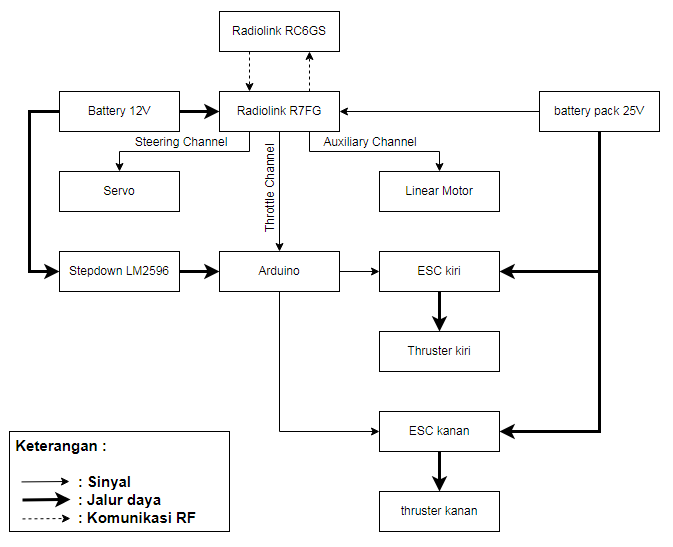
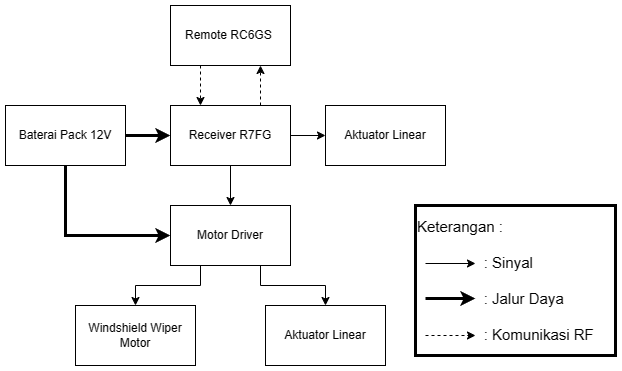
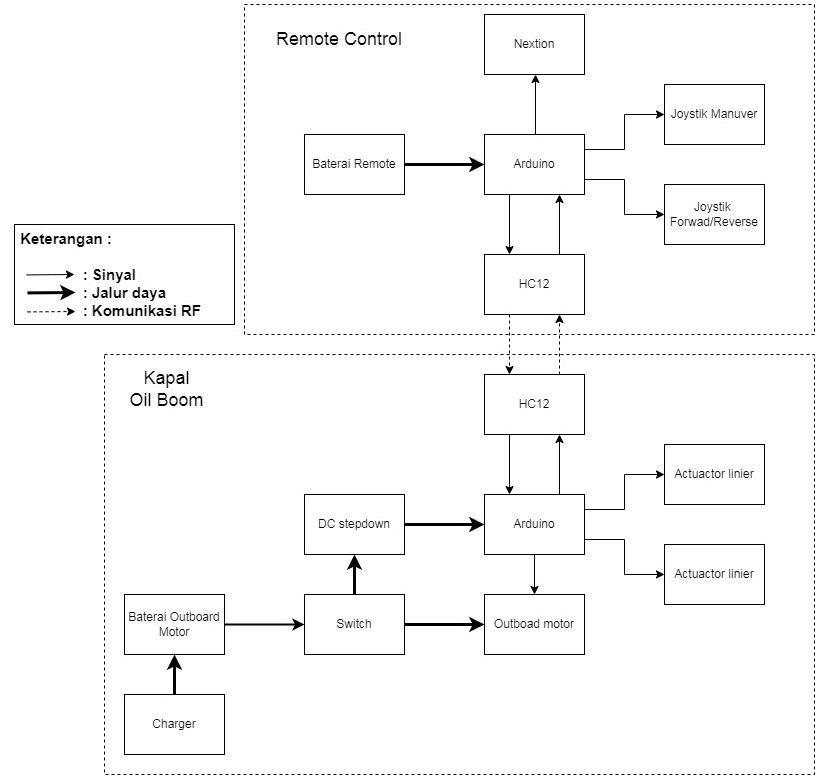
Click a diagram to open it at full size.
Results
The following presents the new-build hull design, the operating concept, and the comparison across the three implementation plans.
New-Build Hull Design
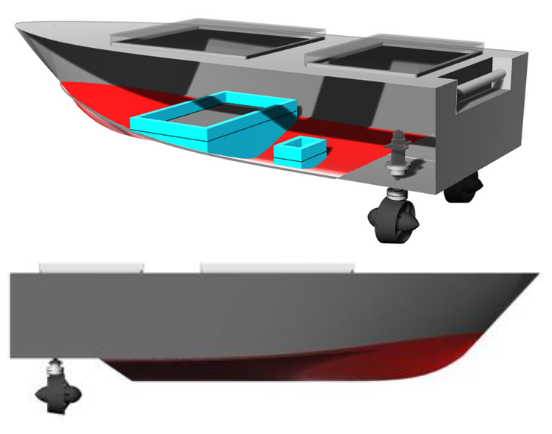
The ITS-built vessel concept uses a monohull form, chosen because it suits shallow, relatively calm water while still handling waves, and its tapered bow helps the vessel maneuver and cut through chop. The hull was designed and simulated in Maxsurf, which supports the Holtrop resistance method and accepts detailed inputs down to hull thickness and material.
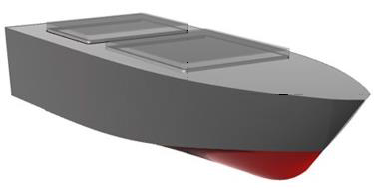
| Specification | Value |
|---|---|
| Dimensions | 180 × 65 × 37.8 cm |
| Weight | 120 kg |
| Max. Thruster Force | 20 kg |
| Remote Control Range | 600 m |
Concept Illustration
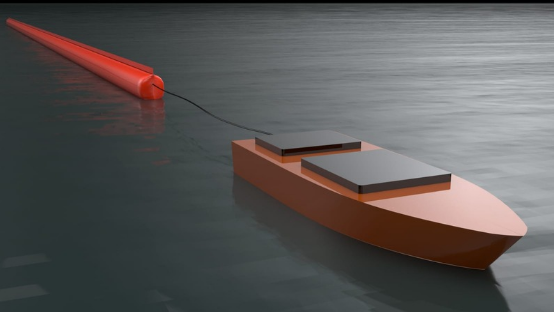
In operation, the vessel tows an oil boom float out to a spill and holds it in place, isolating the contaminated area, in principle by a winch-like towing action controlled entirely from the remote control on shore.
Design Alternatives Comparison
The three plans differ in how much of the vessel is newly built versus reused, which shapes both engineering risk and lead time.
| Design Option | Hull Source | Thruster | Control System |
|---|---|---|---|
| ITS Vessel | New build | New (brushless KYO 20T) | New (RC6GS/R7FG) |
| Partial Modification | Existing (Pertamina) | Existing (retained) | New (RC6GS/R7FG + motor driver) |
| Full Modification | Existing (Pertamina) | New (electric outboard) | Upgraded (HC-12 + Nextion HMI) |
Hull Performance Analysis
The hull geometry for the new-build vessel was modeled in Maxsurf and evaluated using the Holtrop resistance prediction method to estimate propulsion requirements and maneuvering characteristics for shallow-water operation — the same analytical basis naval engineers use to size a vessel's thruster and confirm it can hold course while towing a load.
Key Findings
The project reached the concept-design stage for all three plans but did not proceed to manufacturing, as no partnership agreement with Pertamina had yet been finalized. The comparison shows the partial-modification route as the lightest intervention, reusing the existing hull and thruster, while the full-modification route offers the most capable thruster and control system.
Constraints & Future Development
The main constraint on the project was that no partnership agreement with Pertamina had yet been reached, which kept the work at the concept-design stage. The report also recommends three additions for a future deployable version.
Return-to-Home (RTH)
A GPS-based feature so the vessel can automatically return to its starting point once it reaches a distance or battery limit, without needing constant manual control or an operator watching for low-battery warnings.
Oil-Contamination Sensor
A sensor to detect the extent of an oil spill so the operator can widen the containment area as needed, rather than relying on visual estimation alone.
Current Sensor
A current sensor across the thruster line, compared against battery voltage, so the operator can see how close the thruster is running to its power limit during operation.
Engineering Deliverables
As a concept-design study, the project's outputs were design and planning documents rather than a tested physical system.
Conclusion
The Oil Boom vessel was designed to isolate oil spills in shallow water by towing a boom float under remote control. Three implementation plans were carried through concept design — a new-build ITS vessel, a partially modified Pertamina vessel, and a fully modified Pertamina vessel — but the project had not yet reached the manufacturing stage, pending a partnership agreement with Pertamina as the collaborating partner.
The work still provided practical experience in comparative concept design, naval hull modeling, RF and wireless remote-control system design, and preparation of a multi-party engineering proposal. Future development is recommended to add Return-to-Home (GPS), an oil-contamination sensor, and a current sensor before the vessel is built and deployed.